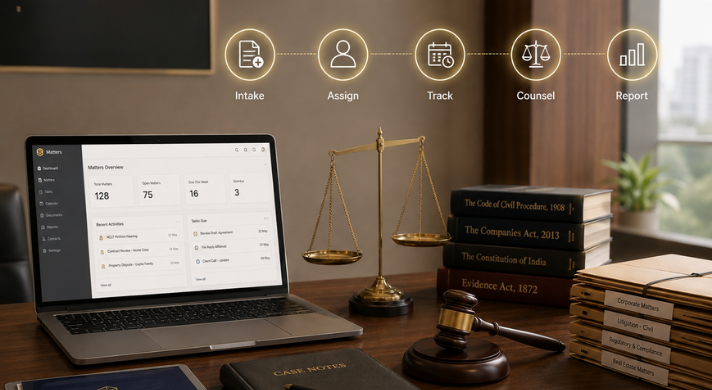
Matter management software is a system that a corporate legal department uses to intake, track, and report on every legal matter - contracts, disputes, advisory requests, and litigation - across its lifecycle. MyKase gives in-house teams one place to route intake, manage external counsel, control legal spend, and pull board-ready reports. This is distinct from firm case management.
The confusion is understandable. A litigation boutique, a full-service firm, and a company's in-house team all say they need software to "manage their matters," yet they want three different products. A law firm bills clients and runs a docket. A sales team runs a CRM. A general counsel sits between the business and its outside lawyers, absorbing requests and answering for a budget. Matter management software for corporate legal departments is built for that third seat.
This article draws the line between matter management, case management, legal matter tracking, and CRM, then tests the real question: does the software actually change how a legal team works, or does it just digitise the same overflowing inbox? We ground the demand-side picture in India's court data and keep the buyer - the general counsel and the legal operations lead - at the centre.
What is matter management software, and who actually uses it?
A matter is any discrete unit of legal work a company owns: a vendor contract, an employment dispute, a trademark filing, a regulatory notice, a piece of advisory the business asks for. Matter management software is the system of record for all of them. It captures the request, assigns an owner, tracks status and deadlines, stores documents, records who is working the matter internally or which external counsel holds it, and reports spend and volume back to leadership.
The user is a corporate legal department, not a solo litigator - a general counsel, a small team of in-house lawyers, a legal operations manager, and the business stakeholders who send work in. Their pain is rarely a single hearing date. It is fifty open items across five business units, three law firms, and no single view of what is happening or what it costs. MyKase's corporate legal request intake and matter management module is built for this reality, giving the team structured intake and a live matter register in place of a shared mailbox.
How is matter management different from case management software?
Case management software is built for law firms that litigate and bill. Its centre of gravity is the case file, the court docket, the hearing calendar, time entries, and the invoice that goes to a client. The firm is the service provider; the software helps it deliver and get paid. MyKase's legal case management software serves that firm-side need directly. When buyers search for "law firm matter management software," this is usually the product they actually want - case management under a different name.
Matter management software sits on the other side of the table. The in-house team is the buyer of legal services, not the seller. It cares less about time entries and client invoices and more about intake triage, internal ownership, external-counsel oversight, and whether the legal budget is on track. A matter may never see a courtroom, since a redlined NDA is a matter too. So while the two overlap on documents and deadlines, they diverge on the core job: one runs a practice, the other runs a function inside a business. That is why, for an in-house team, matter management is the right frame and case handling sits inside it as a matter type rather than the reverse.
Is matter management software the same as legal CRM?
No, and treating them as interchangeable is a common buying mistake. A CRM tracks relationships and pipeline - prospects, clients, business development, who to call next. For a law firm, CRM is a growth tool aimed at winning and retaining clients. Its unit of value is the contact and the deal.
Matter management software tracks work, not relationships. Its unit of value is the matter and its status. A general counsel does not have a sales pipeline; they have a backlog of legal requests and a set of law firms to manage. The two systems answer different questions. CRM asks "who should we sell to?" Matter management asks "what legal work is open, who owns it, and what is it costing us?" A corporate legal department that buys a CRM to run its matters ends up bending contact records into something they were never designed to hold.
How does matter management differ from litigation tracking?
Litigation tracking is narrower. It follows contested cases through the courts: next hearing date, case status, orders, and updates pulled from court systems. For any team with active disputes in India, it is essential, because manually checking cause lists across jurisdictions is unsustainable. MyKase's litigation tracking pulls those updates so nobody refreshes a court portal by hand.
Matter management is the wider container. Litigation is one type of matter among many - the same in-house team also handles contracts, compliance, advisory, and IP that never touch a court. Good matter management software includes litigation tracking as a component but does not stop there; the broader register handles legal matter tracking across every work type, not only disputes. The distinction matters at purchase: a company with a heavy dispute docket may lead with litigation tracking, while a company whose legal work is mostly transactional needs the broader matter register first and litigation tracking as one feed inside it.
Why does the volume of legal work make manual tracking break down?
The scale of contested work in India explains why in-house teams outgrow spreadsheets. The National Judicial Data Grid district-courts dashboard, whose figures were last updated 11 August 2025 and read here in 2026, showed India's district courts alone carrying over 4.99 crore pending cases, split into roughly 1.13 crore civil and 3.85 crore criminal matters. NJDG figures update continuously, so treat this as a dated snapshot rather than a fixed statistic, and note that the district dashboard covers district courts only, not the High Courts or the Supreme Court. A company with operations across states inherits a slice of that backlog, and each dispute generates hearings, documents, and instructions to counsel.
Age compounds the problem. On the same district-courts snapshot, the pending pool broke down as roughly 35% under one year, 24% one to three years, 14% three to five years, 17% five to ten years, and 10% pending for over a decade. A matter that lives for eight years passes through multiple in-house owners and multiple external firms. Without a durable system of record, institutional memory walks out the door with every departure, and the next lawyer starts from a cold file. Matter management software holds that continuity where a spreadsheet or an inbox cannot.
How does matter management software improve legal intake?
Intake is where most in-house workflow quietly fails. Requests arrive by email, chat, corridor conversation, and forwarded threads, each missing half the context the lawyer needs. The team spends its first hour on every request just working out what is actually being asked and by whom. Structured intake replaces the free-text ask with a form that captures matter type, business unit, urgency, and the documents up front.
The workflow effect shows up in a team's own throughput. A defined intake channel gives the general counsel a triage queue in place of a scattered inbox, so work can be prioritised, assigned, and acknowledged with an SLA rather than disappearing into someone's unread mail. MyKase's corporate legal request intake and matter management turns the request itself into the first structured step of the matter, which is where the compounding time savings begin. The business also gets a status it can check, which cuts the follow-up chasing that eats a legal team's day.
Can matter management software actually control legal spend?
Legal spend is the number a general counsel answers for, and it is usually the least visible. External counsel invoices arrive in different formats, against different engagements, at unpredictable times, and the team reconciles them by memory. Matter management software ties every invoice and every hour to a specific matter, so spend is visible per matter, per firm, and per business unit instead of as one lump at year-end.
This changes the conversation with the finance team and with the firms themselves. When a general counsel can see that one dispute has consumed a disproportionate share of the budget, or that one firm's fees cluster around a category of work, they can renegotiate, reallocate, or bring work in-house based on matter-level data rather than year-end memory. There is a tax angle to keep clean too. Under Notification No. 13/2017-Central Tax (Rate), legal services supplied by an advocate or firm of advocates to a business entity fall under reverse charge, so the recipient business entity accounts for the GST itself, and this applies where that recipient's turnover exceeds the GST registration threshold (broadly Rs 20 lakh, or Rs 10 lakh for special-category states). Notification No. 12/2017-Central Tax (Rate) in turn exempts legal services supplied to a non-business entity, to a business below that registration threshold, or to government.
Clean spend records also help a legal team book those external costs against the right service classification. Under the Scheme of Classification of Services, legal work sits under heading 9982, and the sub-codes are not interchangeable: SAC 998211 covers legal advisory and representation in criminal law; SAC 998212 covers advisory and representation in other fields of law, meaning civil, commercial, and labour matters; and SAC 998213 covers legal documentation and certification relating to intellectual property rights such as patents and trademarks. A general counsel who tags each engagement to the correct SAC when the matter is opened, rather than at filing time, can show finance exactly which category of legal work each rupee bought. Matter management software that records the matter type up front makes this a by-product of intake, which is one more reason to keep clean, matter-level records of external legal cost rather than loose invoice files.
How does it change the way in-house teams manage external counsel?
Most companies run several law firms at once, and the relationship is usually managed one email thread at a time. Nobody has a single view of which firm holds which matter, how each is performing, or what each has cost to date. Matter management software tracks external counsel on every matter - which firm, which partner, what scope, what budget, what status.
That visibility shifts the balance. Instead of the firm being the only party who knows the full picture of a matter, the in-house team holds its own record and can hand a matter between firms without losing history. It can compare firms on cost and turnaround, set expectations at engagement, not at invoice, and keep continuity when a matter moves. For a lean legal function, that oversight is often the single biggest workflow gain the software delivers, because managing outside lawyers is where in-house time actually goes.
Should matter management software integrate with the rest of the business stack?
In-house legal work does not sit in a vacuum, and integration is a real line on the buying checklist. An employment dispute connects to HR records, a vendor contract connects to procurement and finance, and legal spend has to reconcile against the accounting ledger. Matter management software that genuinely connects to the systems a company already runs saves the legal team from re-keying the same matter twice; a firm should confirm, system by system, which connections are actually built in rather than assume the word “integration” covers all of them.
Court data is the automatic side of this in MyKase's case: a litigation matter draws its hearing dates and status from the eCourts system rather than a lawyer copying them off a portal by hand. Accounting and ERP are not automatic on MyKase today; legal spend is entered and tracked manually inside MyKase, and reconciling it against a company's Tally ledger or ERP remains a separate step for finance to handle, not a built-in sync.
Does moving to cloud based matter management software carry real risk?
Cloud based legal matter management software raises a fair question about where sensitive legal data lives. In-house teams hold privileged advice, dispute strategy, and commercial contracts - exactly the information a company cannot afford to leak. Any move to a hosted platform has to answer for access control, encryption, hosting location, and audit trails before it earns the legal department's trust.
India's data-protection regime sharpens this. The Digital Personal Data Protection Act, 2023 was enacted in 2023, and its obligations are phasing in through the DPDP Rules, 2025, with most substantive duties including the security-safeguard requirement set to take effect on 13 May 2027, so firms should prepare now rather than treat the duty as already fully enforceable. Section 8(5) of the Act provides that "A Data Fiduciary shall protect personal data in its possession or under its control, including in respect of any processing undertaken by it or on its behalf by a Data Processor, by taking reasonable security safeguards to prevent personal data breach." A legal function processes plenty of such data, which puts security posture on the buying checklist. MyKase documents its cloud and SaaS security controls so a legal team can evaluate the platform against its own risk and compliance requirements rather than take the claim on faith.
What should a corporate legal department look for when choosing matter management software?
Judge the tool by its workflow before its feature list. The decisive questions are whether intake is structured, whether spend is visible at matter level, whether external counsel is a managed dimension, whether the platform integrates with the systems the business already runs, and whether litigation tracking is built in for the disputes the company actually carries. A tool that nails contract storage but leaves intake as free-text email has not solved the real problem.
Then weigh fit and cost against the function's size. A five-person legal team does not need the configuration overhead of a global enterprise deployment, and an enterprise cannot run on a tool with no reporting. Transparent, published pricing helps here - MyKase's pricing lets a team scope the investment against its headcount and matter volume before committing. The goal is software the team will actually adopt, because the best matter management software delivers nothing if the lawyers route around it back to their inbox.
How do you roll out matter management software so the team actually uses it?
Adoption is where most implementations succeed or quietly die. Buying the platform is the easy part; getting every stakeholder to route work through it is the hard part, because the path of least resistance is still a quick email to the lawyer they know. A rollout that survives contact with a busy team removes the informal bypass channels: intake goes through the form, not the inbox, and requests that arrive off-channel get politely redirected back to it until the habit sets.
Sequencing helps the habit form. Start with one high-volume request type - contract review or NDA intake tends to work - prove the queue, then widen to disputes, compliance, and advisory once the register earns trust. Name an owner for the system, usually the legal operations lead, who keeps the matter data clean and reports volume and spend back to the general counsel. When the reports become the number leadership looks at, the tool stops being optional and the workflow change locks in.
Does matter management software genuinely improve workflow, or just digitise the mess?
The honest answer is that it depends on adoption and design. Software that only stores documents digitises the mess without fixing it - the inbox is now a database, but the workflow is unchanged. The improvement comes from three things a general counsel could not do before: triage intake through one structured channel, see legal spend per matter and per firm, and manage external counsel from the buyer's side with a durable record.
Where a team commits to those three, the workflow gain is concrete. Requests get acknowledged and prioritised in place of getting lost, budget conversations rest on matter-level evidence so nobody argues from memory, and continuity survives staff turnover on matters that outlive any single lawyer. Its value is not storage - it is a different way of working. The software is the enabler; the discipline of routing every matter through it is what actually improves the legal team's workflow.
How do matter management, case management, litigation tracking, and legal CRM compare?
| Dimension | Matter management software | Case management software | Litigation tracking | Legal CRM |
|---|---|---|---|---|
| Primary user | In-house / corporate legal team | Law firm (litigation and advisory) | Any team with active disputes | Law firm business development |
| Core unit | The matter (any legal work item) | The case file and docket | The contested case in court | The contact and deal |
| Main job | Intake, spend, external-counsel oversight | Deliver and bill client work | Follow hearing dates and case status | Win and retain clients |
| Billing focus | Controls spend it pays out | Generates invoices it charges | None | None (pipeline value) |
| Scope | Widest - all matter types | Firm caseload | Narrowest - disputes only | Relationships, not work |
| MyKase module | Corporate legal request intake and matter management | Legal case management software | Litigation tracking | Client management features |
Conclusion
Matter management software improves legal team workflow when it is built for the in-house seat and the team commits to using it. Its value is structured intake, matter-level spend visibility, external-counsel oversight from the buyer's side, and integration with the systems the business already runs, with litigation tracking folded in. That is distinct from firm case management, from CRM, and from standalone litigation tracking. For a corporate legal department carrying a share of India's vast pending docket, MyKase gives that single system of record. Book a Demo to see it against your own matter volume.
Frequently Asked Questions
Matter management software is the system an in-house legal team uses to intake, track, and report on every legal matter across its lifecycle. MyKase gives corporate legal departments one place to route requests, manage external counsel, and control legal spend, distinct from firm case management.
Case management serves law firms that litigate and bill clients; matter management serves in-house teams that buy legal services. MyKase supports both, but matter management centres on intake, spend, and external-counsel oversight rather than court dockets and client invoices.
No. A legal CRM tracks relationships and business-development pipeline, while matter management software tracks legal work and its status. MyKase's matter management answers what work is open, who owns it, and what it costs, not who to sell to next.
Corporate legal matter management software is built specifically for a company's in-house legal department: structured intake, a live matter register, spend control, and external-counsel management. MyKase's corporate legal request intake and matter management module is designed for exactly this general-counsel workflow.
Yes. Litigation tracking is one component inside broader matter management. MyKase includes litigation tracking that pulls case status and hearing updates, sitting alongside contracts, advisory, and compliance matters in one register rather than as a separate tool.
It should. Good matter management software connects to accounting and ERP tools such as Tally, to email and document stores, and to eCourts for hearing updates, so matters need no double-entry. MyKase is built to sit inside the stack a company already runs.
It can be, when the platform documents access control, encryption, and hosting. Section 8(5) of the DPDP Act, 2023 requires reasonable security safeguards, with obligations phasing in toward May 2027. MyKase publishes its cloud and SaaS security controls so legal teams can evaluate it.
The best fit is software built for the in-house seat with structured intake, matter-level spend, external-counsel oversight, and built-in litigation tracking for Indian courts. MyKase offers this with transparent pricing. Book a Demo to test it against your own matter volume.