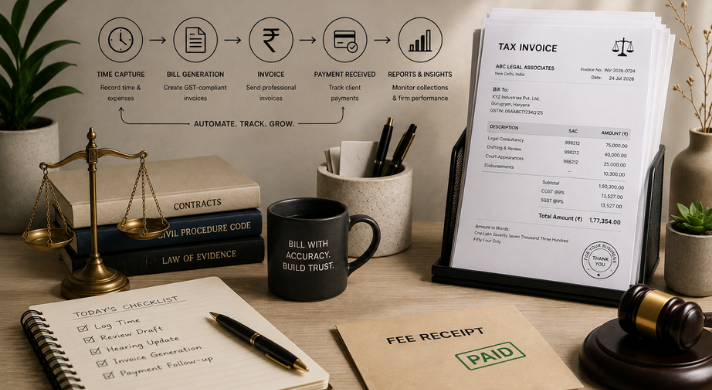
Legal billing software for an Indian law firm records billable time, generates GST-compliant invoices under the correct SAC code, tracks client payments, and holds the accounting entries for the practice. MyKase pairs this billing layer with matter, litigation, and document data so a fee reaches the invoice without re-keying. This guide turns the buying decision into ten questions.
Most firms shop for billing the way they shop for anything: they compare price and feature lists. That is the wrong lens. Billing sits at the point where a firm's work turns into money, and the specific failure modes in India (reverse-charge GST on advocate services, client money that must not mix with firm money, and hearing dates that drive the next fee) do not show up on a global vendor's checklist. A tool built for a US or UK firm can be excellent and still leave an Indian practice reconciling by hand.
The ten questions below run in the order a considered evaluation follows: what the tool captures, how it invoices, how it collects, and whether it holds up against Indian tax and data law. Ask them of any product, MyKase included, and let the answers rather than the brochure decide.
What should legal billing software actually do for an Indian firm?
At minimum, legal billing software captures time and expenses against a matter, converts them into an invoice, records what the client pays, and keeps the books straight. For an Indian firm the definition stretches further. The invoice has to carry the right SAC code and GST treatment, the receipt has to survive scrutiny, and the whole trail has to reconcile to a specific matter and client. Billing that cannot name the matter behind a line item is a spreadsheet with extra steps.
The practical test is whether billing is a module inside your practice system or a bolt-on that lives apart from your cases. When billing sits alongside matter and hearing data, a lawyer who logs work against a case has already started the invoice. MyKase treats billing as one face of the same record that carries the matter, its documents, and its litigation history, so the number that reaches the client traces back to real work rather than a memory of it. The ten questions that follow are the ones to press before you sign.
Does the tool support trust accounting and keep client money separate?
Client money held for a matter, such as settlement funds, advances, or amounts kept against future disbursements, is not the firm's income until it is earned or spent. This is not only prudent bookkeeping; it is a professional duty. Under the Bar Council of India Rules framed under the Advocates Act, 1961 (Standards of Professional Conduct and Etiquette), an advocate must keep proper account of a client's money and may not divert those funds to personal or office use. Mixing client money with operating funds therefore invites both a client dispute and a conduct question.
Trust or client-ledger accounting keeps those balances distinct, records every movement against the matter it belongs to, and lets you show, on demand, exactly what you are holding for whom. When you evaluate legal billing software for Indian law firms, ask how the tool handles a client advance that is drawn down across several invoices over months. Can it show the running balance per matter? Does it stop you invoicing against money that is not there? A billing tool that treats every rupee received as firm revenue forces you to run a parallel ledger by hand, which defeats the purpose of buying software at all.
How does it capture billable time before the hours leak away?
Unrecorded time is unbilled time. The gap between doing the work and writing it down is where a practice loses fees it never records: a call taken in a corridor, a draft reviewed at night, twenty minutes that never made it into any record. The value of billing software is decided here, at capture, long before the invoice stage that vendors like to demo.
Look for capture that meets lawyers where they work: a timer on the matter, quick entry from a phone, and the ability to turn a logged task or a hearing attendance into a billable line without opening a second system. Because MyKase holds the matter, the calendar, and the billing in one place, time logged against a case is already attached to the client it will be billed to. Ask any vendor to show capture on a mobile device, since that is where most lost minutes are actually recoverable.
Will it produce GST-compliant invoices under the right SAC code?
Legal services in India sit under heading 9982 (legal and accounting services), group 99821 (legal services), in the CBIC Scheme of Classification of Services annexed to Notification 11/2017-Central Tax (Rate). The codes are not interchangeable. Criminal law advisory and representation falls under SAC 998211; advisory and representation in other fields of law (civil, commercial, labour) falls under SAC 998212; documentation and certification concerning patents, copyrights, and other intellectual property rights is SAC 998213; other legal documentation is SAC 998214. An invoice that omits the applicable SAC code, the client's GSTIN where required, or the correct tax treatment is not merely untidy; it can be rejected and it complicates the client's own input credit.
The harder part is reverse charge. Under Notification 13/2017-Central Tax (Rate), tax on legal services supplied by an advocate or firm of advocates to a business entity is payable by the recipient rather than the advocate, and this reverse charge applies where the recipient business entity's turnover exceeds the GST registration threshold. Notification 12/2017-Central Tax (Rate) then exempts legal services supplied to any person other than a business entity, or to a business entity whose aggregate turnover in the preceding financial year is below that registration threshold (Rs 20 lakh in most states; Rs 10 lakh in special-category states). Your billing tool has to invoice correctly across all three cases.
Can it track receivables and chase them automatically?
An invoice is a claim, not cash. Collections is the discipline of turning that claim into money, and it is where firms leave the most on the table. In many practices the bigger leak is not unpaid invoices but uncollected ones: invoices issued, then left unfollowed because no one owns the reminder. Software earns its keep by making the outstanding position visible and the follow-up automatic. Ask what the tool does the day after an invoice falls due. Does it flag the ageing, prompt a reminder, and record part-payments against the right matter?
Ageing is the single most useful number in a firm's finances, and it is too often kept in a stale spreadsheet. A live ageing report, sorted by how long amounts have been due and by client, tells a managing partner where to spend a difficult phone call this week. The question to press is whether ageing updates itself. If a receipt logged against a matter automatically clears the right invoice and adjusts the ageing, the report is trustworthy; if someone re-enters payments into a separate finance sheet, it is always slightly wrong and stops being trusted. For firms evaluating billing software for law firms, this collections view matters more than the invoice template. MyKase keeps receipts, invoices, and matters on one record, so the outstanding position reflects reality without a reconciliation ritual.
Global tool or Indian tool: which fits an Indian practice better?
A global billing tool is often mature, polished, and genuinely good at time capture and invoicing. What it usually is not built for is the Indian tax and court context: reverse-charge GST on advocate services, SAC codes, and the rhythm of hearing dates that drives litigation billing. You can bolt these on, but every bolt-on is a manual step that breaks the first busy month.
The scale of that court context is easy to underestimate. India's District Courts alone carried roughly 4.99 crore pending cases on the National Judicial Data Grid (NJDG dashboard last updated August 2025, accessed 2026; figures update continuously, and this covers district courts only). Each of those matters carries adjournments and appearances that a litigation practice bills against. An India-first tool starts from that reality. It assumes GST, it assumes matters that live in courts with adjournments, and it assumes the invoice must reconcile to Indian records. The trade-off is usually breadth of integrations. Neither choice is automatically right; the honest question is how much manual Indian-context work the global tool leaves you doing every month.
Does it connect to your matters and your accounting system?
Billing that stands alone forces double entry: once in the case system, again in the finance tool. Every re-key is a chance to bill the wrong matter, miss an expense, or lose a disbursement. The firms that bill cleanly are the ones where a fee never leaves the record it was earned on.
This is where an integrated system separates from a point tool. When billing sits with legal case management software, an expense attached to a matter should flow to the invoice; when it sits with litigation tracking, an appearance at a hearing should become a billable line; when it sits with document management, the fee note and its supporting papers should live together. Verify this in a live demo rather than taking it on the brochure. Ask each vendor to trace one disbursement from the day it was incurred to the day it appears on a client invoice, and watch how many systems the answer touches.
Most Indian firms keep their books in Tally... Before you choose any billing tool, ask what its export path actually looks like... On MyKase specifically, the honest answer is that there is no confirmed, automatic two-way sync into Tally or a similar accounting package today. Invoices and GST detail are entered and managed inside MyKase, matter by matter, and moving that data into the firm's statutory books remains a separate step for the firm's own bookkeeper or accountant. MyKase does support general legacy data import and API integrations for adjacent software, which is not the same thing as an ongoing accounting sync.
Is my client and financial data secure and compliant with Indian law?
Billing data is among the most sensitive a firm holds: client identities, fee arrangements, financial positions. The Digital Personal Data Protection Act, 2023 speaks to this directly. Section 8(5) provides that a Data Fiduciary shall protect personal data in its possession or under its control, including in respect of any processing undertaken by it or on its behalf by a Data Processor, by taking reasonable security safeguards to prevent personal data breach. The Act was enacted in 2023, and its obligations are phasing in: the DPDP Rules 2025 were notified in November 2025, with most substantive duties, including this security-safeguard compliance, taking effect on 13 May 2027. The exposure is not fully enforceable today, but a firm building its practice stack now is wise to choose tools that already meet the standard.
Ask where the data is hosted, who can access it, how access is logged, and what happens in a breach. A serious vendor answers precisely and points to its cloud and SaaS security posture rather than waving at buzzwords. Because MyKase runs on managed infrastructure with role-based access and audit trails, a firm can show the reasonable security safeguards Section 8(5) will expect rather than scramble to build them when the deadline arrives.
How does it handle retainers, advances, and part-payments?
Real firms rarely get paid in one clean instalment against one invoice. A client pays a retainer, work is drawn against it, a further advance arrives, an invoice is part-settled, and a disbursement is reimbursed separately. Billing software that assumes one invoice equals one payment breaks on contact with how Indian firms actually collect.
Test the messy case. Log a retainer, raise two invoices against it across two months, apply a part-payment to one, and check whether the client ledger still balances and the ageing still reads true. A tool that survives that walkthrough will survive your practice. MyKase models advances and part-payments against the matter ledger so the running balance stays correct without a parallel spreadsheet holding the real numbers.
What should billing software cost, and how should a small firm weigh it?
Price belongs at the end of this list, and here is why: the cost of billing software is trivial against the fees it stops you leaking. Recovered billable time that would otherwise go unrecorded usually outweighs the licence, while a cheaper tool that leaves you reconciling GST by hand costs partner time you cannot bill. Judge cost against recovered revenue, not against the licence line alone, and insist the pricing be legible: per-user, predictable, no surprise modules for the GST invoicing you assumed was included. Confirm what the quoted plan actually covers before you sign, and check the pricing against the workflows these ten questions surfaced.
A small firm should weigh the same questions with a different priority order. A two-partner practice does not need the depth a hundred-lawyer firm does, but the failure modes are identical and hurt more, because there is no finance team to catch a mistake. For legal billing software for small firms, fast time capture and clean GST invoicing come first, since those recover cash immediately, while elaborate reporting can wait. Weigh onboarding honestly too: the best small law firm billing software is the one a busy lawyer runs without a dedicated administrator and actually uses on a Tuesday afternoon, not the one with the longest feature list.
What to check when comparing legal billing software in India
| Evaluation area | Buyer question to ask | Why it matters in India |
|---|---|---|
| Trust / client accounting | Can it hold client advances separate from firm income, per matter? | Bar Council of India Rules require an advocate to account for client money and not divert it; disputes follow if it mixes |
| Time capture | Is there mobile and timer-based capture on the matter? | Unrecorded minutes are unbilled fees; capture decides recovery, not the invoice |
| GST invoicing | Does it apply the right SAC code (998211 criminal, 998212 other fields, 998213 IP, 998214 other documentation) with correct reverse-charge treatment? | Notifications 13/2017 and 12/2017-CT(Rate) govern advocate legal services; wrong treatment breaks client input credit |
| Collections & ageing | Does receivables ageing update automatically from receipts? | A stale ageing sheet means invoices go unchased and cash sits idle |
| Integration | Does billing connect to matter, litigation, and document records? | Standalone billing forces double entry and mis-billed matters |
| Accounting export | Can invoices and receipts move into Tally or Zoho Books cleanly? | Most firms keep statutory books in Tally; confirm this before assuming it, since MyKase itself does not yet offer a confirmed automatic sync |
| Data security | Where is data hosted, and does it meet DPDP Act 2023 safeguards? | Section 8(5) requires reasonable security safeguards; obligations phase in to 13 May 2027 under the DPDP Rules 2025 |
| Cost | Is pricing per-user and predictable, with GST invoicing included? | Value is measured against fees protected, not the licence line |
Conclusion
Choosing legal billing software in India is a decision about where your firm's work turns into money, and the risks that matter are Indian: trust accounting under the Bar Council rules, GST under the correct SAC code and reverse-charge notifications, and the data safeguards the DPDP Act will expect by 2027. On accounting export, confirm with any vendor, MyKase included, what moves automatically into Tally and what your accountant still enters by hand.
Frequently Asked Questions
The best fit is the one that captures time cleanly, applies the correct SAC code with the right reverse-charge treatment, and connects billing to your matters. .
Yes. Small firms should prioritise fast time capture and compliant GST invoicing over heavy reporting, since those recover cash immediately. MyKase runs without a dedicated administrator, so a two-partner practice can log time and raise a compliant invoice in minutes.
Legal services fall under heading 9982, group 99821. Advisory and civil representation is SAC 998212, criminal work is 998211, IP documentation is 998213. Under Notification 13/2017-CT(Rate), tax on advocate services to business entities above the registration threshold is paid by the recipient on reverse charge.
Global tools are polished but rarely handle reverse-charge GST, SAC codes, or hearing-driven billing without manual work. An India-first tool like MyKase allows users to add the correct SAC codes and record applicable Reverse Charge GST details against court matters from the start, reducing the monthly manual reconciliation a global tool leaves behind.
It should. Under the Bar Council of India Rules an advocate must account for client money separately, so advances and settlement funds stay distinct from firm income and tracked per matter. MyKase holds advances against the matter ledger, keeping the running balance correct without a parallel spreadsheet.
On MyKase, there is no confirmed, automatic sync into Tally today. Invoices and GST detail are managed inside MyKase, and moving that data into a firm's statutory books remains a manual step for the firm's own accountant. Ask any vendor to show the exact file format before assuming month-end reconciliation is automatic.
By making receivables visible and follow-up systematic. Live ageing shows who owes what and for how long, and receipts clear the right invoice automatically. MyKase keeps invoices, receipts, and matters on one record so the outstanding position reflects reality.
Billing data is sensitive. The DPDP Act 2023, Section 8(5), requires a data fiduciary to take reasonable security safeguards to prevent a personal data breach, with obligations phasing in to 13 May 2027 under the DPDP Rules 2025. MyKase runs on managed infrastructure with role-based access and audit trails to support those obligations.